Is Your Oven's Temperature Sensor Lying to You? Uncovering the Truth Behind Consistent Baking Results
Key takeaway: Oven Temperature Accuracy for Baking is not determined by the number glowing on the control panel alone. An oven can reach a nominal setpoint while its air temperature cycles above and below that value, its cavity contains hotter and cooler zones, and its sensor measures a location that does not perfectly represent the environment surrounding a baking pan. The result is an important distinction: measurement is not the same as control. A sensor can be functioning normally while the baking result still differs from what the recipe seems to predict.
That distinction matters because baked foods respond to heat as a process, not as a single number. Batter expands, proteins set, water moves and evaporates, fats melt, starches gelatinize, and surfaces brown while the oven is simultaneously exchanging radiant, convective, and conductive heat with the food. A modest temperature error can therefore change the timing of several processes at once. The practical goal is not to make an ordinary household oven behave like a laboratory furnace. It is to determine whether the oven's thermal behavior is consistent enough for the kind of baking you are doing, and to recognize when the evidence points to a real calibration or service problem.
The sensor may be telling the truth about its location
The phrase “lying sensor” is useful as a question but misleading as a diagnosis. An oven sensor generally reports the temperature at, or inferred from, its own sensing location. The controller then uses that information to switch heating elements or other heat sources on and off. Neither the sensor nor the controller is necessarily designed to guarantee that every point in the cavity equals the displayed setpoint.
This is a fundamental measurement problem. NIST's discussion of temperature measurement emphasizes that sensor behavior can be affected by dynamic and installation effects. In an oven, the sensor has a physical position, thermal mass, response time, and surrounding environment. Its reading can change differently from the temperature of a pan sitting several inches away. The control system may also deliberately allow a temperature band rather than holding an absolutely fixed value.
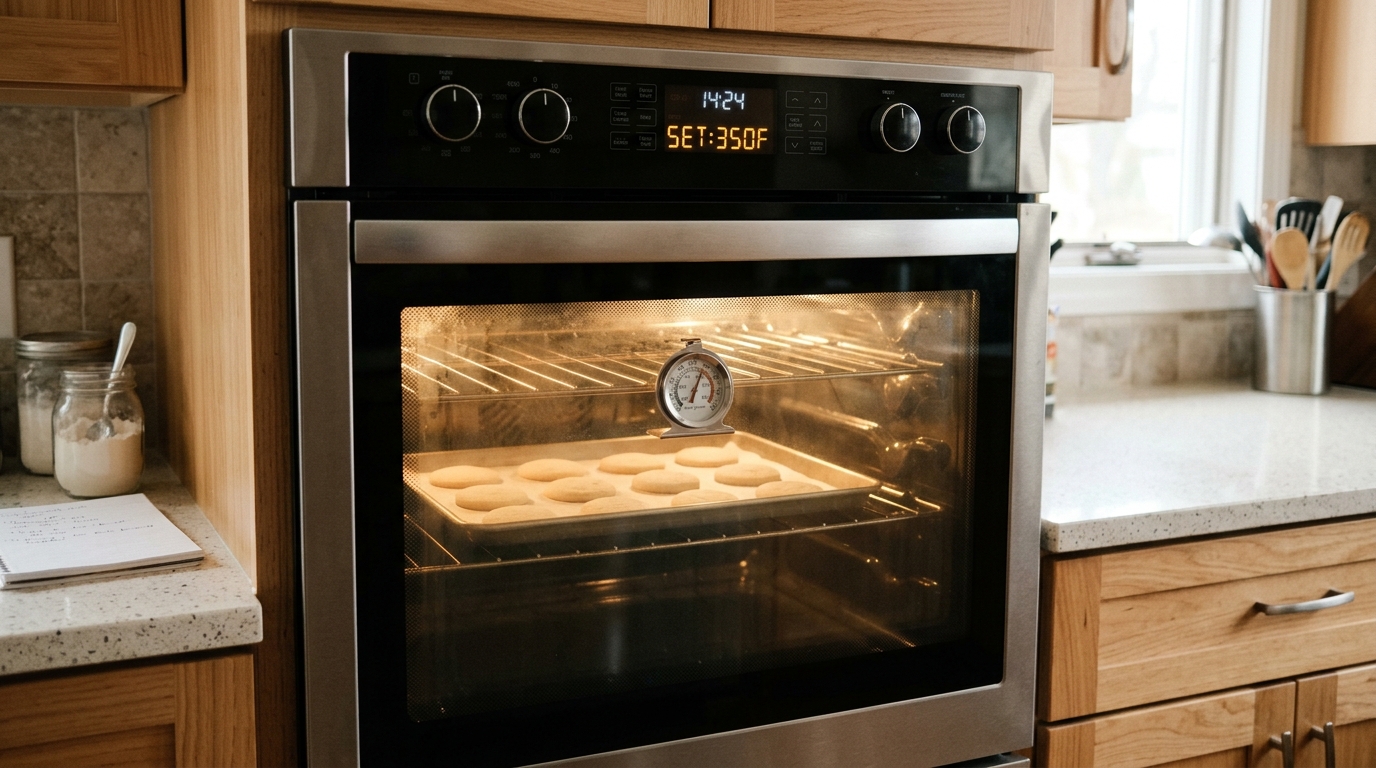
So if a display says 350°F, that should normally be interpreted as the oven's control target, not as a promise that the center of the baking rack is continuously and exactly 350°F. This is why an independent oven thermometer is useful when the objective is to verify the oven's displayed temperature rather than simply trust the display.
Why a “350°F oven” does not stay at 350°F
Household ovens commonly regulate temperature by cycling heat. After preheating, the heating system may shut off as the measured temperature approaches the control target, then switch back on after the temperature falls sufficiently. The resulting temperature curve is dynamic rather than flat.
That cycling is not automatically evidence of malfunction. The important question is whether the pattern is compatible with the recipe and whether the average thermal behavior is reasonably repeatable. A sensor can be accurate enough for the controller's intended job while the instantaneous air temperature moves above and below the setpoint.
The distinction becomes clearer if three quantities are separated:
This table explains why replacing a sensor is not automatically the correct response to inconsistent baking. If the sensor reading is plausible but the cavity has strong hot and cool regions, a new sensor may leave the underlying problem untouched.
The science of the oven hot spot
Research on oven temperature uniformity shows that spatial variation is real rather than merely anecdotal. A 2023 Scientific Reports study measured an oven cavity at multiple points using distributed thermocouples and reported differences of 10°C or more between some locations in the tested configuration. The precise size of the difference is not a universal specification for every household oven, but the finding illustrates the central point: one oven can contain multiple thermal zones.
Radiation makes the situation more interesting. A heating element or hot oven wall can transfer energy directly toward the surface of a pan or food. Meanwhile, air movement transports heat through convection. The pan itself then conducts heat into the food. A sensor that mainly represents the air near one wall cannot completely describe all of those heat-transfer paths.
This helps explain a familiar baking pattern: a tray may brown more strongly on one side even when the oven's displayed temperature appears stable. It also explains why changing rack position, pan orientation, or convection mode can alter the result without changing the recipe temperature.
A peer-reviewed cake-baking study provides a useful example. Researchers measured temperatures at several oven locations as well as inside the cake and found that airflow changed oven-temperature oscillation, heat penetration, cake expansion, crumb structure, and moisture loss. In other words, the thermal environment surrounding the food influenced the finished product even when the nominal baking temperature was part of the same experimental setup.
Airflow is part of the temperature story
Convection is sometimes described simply as “hot air moving,” but for baking it is more useful to think of airflow as a heat-transfer variable. Moving air can change how quickly heat reaches the food surface, how efficiently moisture leaves the surface, and how evenly different regions of the cavity exchange heat.
The 2015 peer-reviewed study on cake baking found that airflow reduced the oscillation of the measured oven temperature profile and increased the rate of heat penetration into the cake under the tested conditions. It also changed the cake's expansion and final moisture characteristics. Those results do not mean that convection is universally better. They mean that the oven mode changes the thermal process.
This is an important exception when interpreting a suspected sensor error. If a recipe was developed for conventional heating and the oven is switched to convection, a different result does not prove the sensor is inaccurate. Likewise, if a convection oven produces uneven browning, the explanation may involve airflow distribution rather than the sensor itself.
What inconsistent baking can and cannot prove
A failed cake, pale cookies, or an over-browned crust is evidence of a problem with the overall baking process, but it is not by itself evidence that the temperature sensor is defective. Ingredient temperature, flour characteristics, pan dimensions, rack position, dough thickness, loading, humidity, altitude, and mixing can all change the result.
That is why a useful diagnosis begins with repeatability. If the same recipe, same pan, same rack position, same oven mode, and substantially similar preparation repeatedly produce the same directional problem, the oven becomes a stronger suspect.
There is also a counterexample worth keeping in mind. At high elevations, atmospheric pressure changes can alter cake structure and evaporation independently of oven accuracy. Colorado State University Extension notes that cakes may require recipe and temperature adjustments at sufficiently high elevations. Therefore, changing the oven setting is not always the right fix for a baking failure that happens in a high-altitude kitchen.
A practical self-check before calling the sensor faulty
The most useful home test is a controlled comparison, not a single glance at a thermometer. USDA FSIS recommends using an oven thermometer to check whether an oven is heating to its desired temperature and describes checking the oven at multiple settings. The agency also notes that ovens cycle as they maintain temperature.
For a baking-focused investigation, consistency matters more than chasing one dramatic number. Place an independent oven thermometer in a representative central rack position. Preheat according to the oven's normal procedure. Once the oven indicates that it has reached the set temperature, observe the thermometer without repeatedly opening the door. Record the behavior over a meaningful period rather than treating the first reading as definitive.
If the thermometer is consistently offset from the setpoint across several settings, that pattern is more informative than a one-time deviation. USDA FSIS gives the example of an oven that is consistently high or low by the same amount; such a stable offset can sometimes be accounted for in the setting, subject to the manufacturer's instructions and the needs of the recipe.
However, if the readings swing unpredictably, differ substantially by rack position, or fail to settle after adequate warm-up, the evidence points toward a broader control, sensor, heating, airflow, or insulation issue. At that point, treating the oven as “just 25 degrees hot” may hide rather than solve the problem.
Self-check checklist: separate an offset from a thermal pattern
- Use the same rack position for repeated measurements.
- Keep the independent thermometer away from the oven wall and heating element.
- Preheat fully before interpreting the measurement.
- Allow the oven to stabilize rather than judging it immediately after the heat indicator changes.
- Record more than one temperature observation because cycling is normal.
- Repeat the test at several common baking settings if the first test suggests an offset.
- Compare results across rack positions if uneven browning is the main complaint.
- Repeat the baking test with the same recipe, pan, load, and oven mode before changing several variables at once.
- Separate a consistent offset from a large or erratic fluctuation.
- Stop treating the issue as a simple calibration problem if the oven shows unstable or unsafe behavior.
Why stabilization time matters more than a quick thermometer glance
Temperature measurement is dynamic. The thermometer itself takes time to respond, and the oven is continuously exchanging heat with its walls, racks, air, and food. Opening the door adds another disturbance. For that reason, a measurement taken immediately after the heating element switches off can describe a transient condition rather than the operating behavior relevant to a long bake.
NIST's calibration literature emphasizes the importance of understanding dynamic and installation effects in temperature measurement. Industrial and laboratory oven procedures likewise allow time for stabilization before accepting readings. A household oven does not need laboratory-level calibration for ordinary baking, but the reasoning still applies: if the measurement method is unstable, the conclusion will be unstable too.
This is one reason a cheap-looking test can become surprisingly misleading. A thermometer can be perfectly functional yet be placed in a location where it receives unusually strong radiant heat, or it can be read before reaching thermal equilibrium. The question is therefore not simply “Is my thermometer accurate?” but “Is my measurement setup appropriate for the question I am asking?”
When should you adjust, compensate, or seek service?
The decision threshold should depend on the pattern of evidence.
If the oven is consistently high or low by a similar amount at several settings: treat this as a possible calibration or stable-offset problem. Check the manufacturer's instructions for user calibration or temperature-offset adjustment. If the oven permits compensation, document the measured offset and verify the result afterward.
If the oven varies normally around the target but baking is repeatable: there may be no fault to correct. The cycling is part of the control strategy. Focus on recipe-specific factors such as rack position, pan choice, convection mode, and bake time.
If the center is acceptable but one rack area repeatedly burns or underbakes: investigate spatial uniformity and airflow before blaming the sensor. Move the same test pan to another rack position and compare results under controlled conditions.
If the temperature behavior is erratic, the oven struggles to reach temperature, or the reading changes implausibly: service becomes more appropriate. A sensor, control board, heating element, relay, wiring, door seal, or another component may be involved, and a home offset adjustment may only mask the symptom.
If the baking result changed after changing ingredients, altitude, pan material, oven mode, or load: do not diagnose the sensor from the food result alone. Restore the previous conditions first and test one variable at a time.
NIST does not prescribe one universal recalibration interval for all measuring instruments. Its guidance says intervals depend on accuracy requirements, instrument stability, environmental factors, and the application. That principle is particularly useful for home baking: a person baking occasional cookies does not necessarily need the same verification routine as someone relying on tightly controlled thermal conditions for repeated production.
Calibration tools measure a question, not a feeling
Oven calibration tools are valuable when they answer a clearly defined question. An independent thermometer can answer whether the cavity temperature near a chosen location broadly agrees with the setpoint. A multi-point thermocouple setup can investigate spatial differences. A data logger can reveal cycling and recovery behavior over time.
These are different questions. Using a single thermometer cannot map an entire oven. Conversely, mapping the whole cavity may be unnecessary if the practical problem is simply a stable 15°F offset during ordinary cake baking.
The distinction is especially important because a measurement device can have its own uncertainty. NIST's temperature-measurement work emphasizes traceability and known uncertainty rather than treating every numerical reading as absolute truth. For household baking, the practical lesson is not that every thermometer needs laboratory certification. It is that the confidence of the conclusion should match the quality of the measurement.
The action threshold: what evidence is strong enough?
A useful threshold is based on repeated patterns rather than a single dramatic observation.
The most important trade-off is between precision and relevance. More measurements can reveal more detail, but excessive testing can become counterproductive if it obscures the actual baking problem. The right measurement is the simplest one that can distinguish between the plausible explanations.
FAQ: oven sensors, calibration, and baking consistency
1. Does a 350°F setting mean the oven is always 350°F?
No. The setting is the control target. During normal operation, the oven can cycle above and below that target, while different parts of the cavity can have different temperatures. What matters for baking is the thermal environment experienced by the food over time.
2. Can an oven sensor be accurate while my cookies still bake unevenly?
Yes. A sensor can correctly report the temperature at its own location while another region of the cavity receives different amounts of radiant heat or airflow. Uneven browning therefore does not automatically prove that the sensor is defective.
3. How can I tell whether my oven has a stable temperature offset?
Use an independent oven thermometer in a consistent central location and compare the measured behavior with the setpoint at several baking temperatures. A similar directional offset across repeated tests is stronger evidence of a stable calibration issue than one isolated reading.
4. Should I replace the temperature sensor if a cake fails?
Not based on the cake alone. Ingredient changes, pan geometry, rack position, convection mode, loading, altitude, and mixing can all affect the result. First reproduce the problem under controlled conditions and independently check the oven temperature.
5. Why does the oven thermometer move up and down instead of staying fixed?
Temperature cycling is expected in many controlled ovens. The heating system switches on and off as it regulates the cavity. A moving reading is not automatically a fault; the amplitude, timing, repeatability, and effect on baking are more informative.
6. Can convection make a correctly calibrated oven bake differently?
Yes. Airflow changes heat transfer and can change the rate at which food heats, loses moisture, expands, and browns. Peer-reviewed cake-baking research has demonstrated measurable differences in oven temperature behavior and cake characteristics under different airflow conditions.
7. How often should an oven thermometer or calibration setup be checked?
There is no universal interval that applies to every use case. NIST notes that calibration intervals depend on accuracy requirements, stability, environmental factors, and the application. For home baking, repeat the check when baking behavior changes, after relevant service or repairs, or when consistency becomes important enough to justify verification.
8. Is an oven thermometer enough to prove an oven is accurate?
No. It can provide useful evidence about temperature at its measurement location, but it cannot completely characterize spatial uniformity, sensor response, airflow, radiant heating, or the temperature inside the food. For most home-baking questions, however, it is a useful first diagnostic step.
9. When should I stop compensating by changing the recipe temperature?
If the oven shows a stable offset that has been repeatedly verified, compensation may be reasonable when permitted by the manufacturer and appropriate to the recipe. If the oven is erratic, cannot stabilize, or behaves very differently from one test to another, compensation is a poor substitute for diagnosis or service.
10. Why can the food temperature differ from the oven temperature?
Heat has to travel from the oven environment into the food. The rate depends on the food's composition, geometry, moisture, surface conditions, pan, airflow, and surrounding heat transfer. A cake can therefore have an internal temperature trajectory that is quite different from the oven-air trajectory.
Information synthesis: the sensor is only one part of the system
The evidence points toward a more useful answer than simply declaring an oven sensor truthful or deceptive. The sensor is one component in a feedback system. The displayed temperature is a control target. The cavity has spatial and temporal temperature variation. Airflow changes heat transfer. Radiant surfaces affect browning. The food itself has its own heating curve.
That is why reliable baking begins with a hierarchy of evidence. First ask whether the baking problem is repeatable. Then verify the oven with an independent measurement. Next distinguish a stable offset from ordinary cycling and from spatial nonuniformity. Finally, decide whether a simple documented adjustment is sufficient or whether the pattern warrants qualified service.
The strongest practical conclusion is therefore conditional: if an independent measurement repeatedly shows a stable offset, investigate calibration; if the offset disappears but baking remains uneven, investigate thermal zones, airflow, pan position, and recipe variables; if the temperature behavior is erratic or cannot be stabilized, treat it as a potential equipment problem rather than endlessly compensating in the recipe.
Consistent baking does not require pretending that a household oven is thermally perfect. It requires knowing what the number on the display actually represents, measuring carefully enough to challenge that assumption, and choosing an action threshold that matches the evidence. Once those distinctions are clear, the mysterious “lying sensor” becomes a much more manageable question of temperature control, heat transfer, measurement uncertainty, and repeatable process design.


Comments
Post a Comment